
Reviewed · RIGA OLD TOWN WALKING TOURS
2 Hours Walking Tour in Legends and Secret of Riga’s Old Town
Riga’s Old Town is more than a pretty collection of church towers and ornate facades. With Lina, you follow the stories tucked into narrow lanes, old cellar walls, guild symbols, church roosters, execution bells, and a black cat perched high above the street. The legends give the city a human face, while the route helps you understand how Riga grew from a medieval trading town into Latvia’s capital.
I especially like two things here. First, the private format for up to six people gives Lina room to answer questions and adjust the pace. Second, the walk includes small details you could easily miss alone, including Rozena Street, the old fortification wall, the Baltic Way marker, and a cellar or underground passage associated with medieval Riga. The tasting of Riga Black Balsam adds a local flavor without turning the tour into a drinking outing.
The main consideration is scope. The walk is advertised at about two hours and thirty minutes, but it covers a very long list of stops. You see many churches, museums, and buildings from outside or in free sections, rather than receiving full interior visits. Wear good shoes, keep an open mind about the fast-moving itinerary, and confirm the exact pickup point before setting out.
Key things to know before you book
- Black Balsam tasting: Sample Riga’s famous herbal drink at Black Magic Bar and hear the story of its supposed connection to an old pharmacy and alchemist.
- A private group of six or fewer: You get a more personal walk, with time for questions and possible restaurant and museum suggestions.
- Legends alongside city history: Expect stories about church roosters, a ghost, a black cat, walled-up monks, medieval taxes, and the first decorated Christmas tree.
- Many small Old Town stops: The route includes major sights plus narrow streets, gates, guild buildings, markers, and bits of surviving fortification.
- Useful first-day orientation: The route touches most of central Vecriga, making it a good opening activity if you want to choose museums and restaurants afterward.
- Mostly an exterior tour: Several churches and museums are viewed from the street, with access limited to free areas where specified.
A story-led introduction to Vecriga
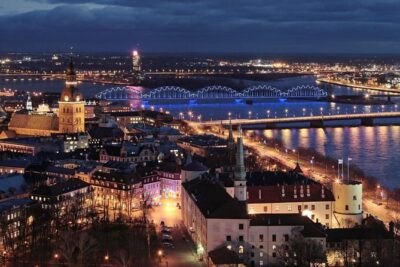
This walk works best as an orientation with character. Riga’s Old Town, known locally as Vecriga, can feel like a maze of cobbled lanes and medieval-looking buildings. Lina’s approach gives you a thread to follow. Instead of simply naming buildings, she explains why a rooster sits on a church tower, how merchants measured their day, and what the symbols on a facade were meant to say.
Her teaching also benefits from visual material. She has used a folder of historical photographs to show how buildings looked before fires, wartime damage, and repairs. That matters in Riga, where the past is not always visible in one glance. A restored facade may look complete until you see an older image beside it.
I would schedule this near the beginning of your stay. The route passes museums, churches, restaurants, squares, and major meeting points. You can mark places to revisit later, including the Latvian War Museum in Powder Tower, the cathedral, and the House of the Black Heads.
The walk is described as two hours, but the detailed route and past tour timing suggest you should allow closer to two and a half hours. The pace is generally manageable, though the number of stops means some visits are brief. You will be standing outside for much of the time, so comfortable shoes and weather-ready clothing are sensible.
More riga old town walking tours in Riga:
- Riga Old Town walking tour
★ 4.5 · 304 reviews - Riga Old Town Walking Tour in a Small Group
★ 4.5 · 132 reviews - Private Riga Old Town Walking Tour
★ 5.0 · 62 reviews
St. Peter’s Church and Town Hall Square
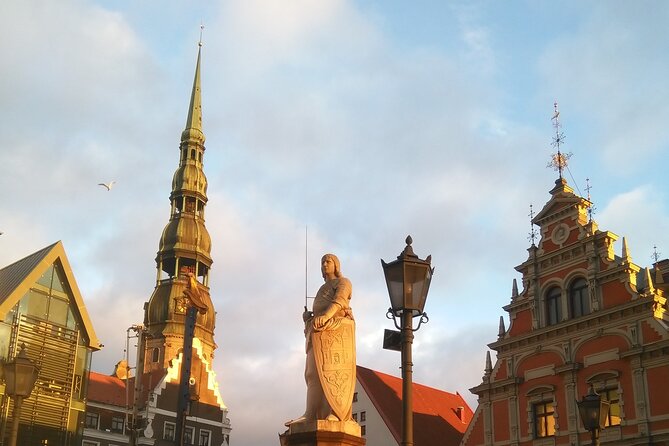
The opening stop is St. Peter’s Church, one of Riga’s oldest Lutheran churches. You observe the exterior and enter the free part rather than taking a full paid church visit. Lina explains the church’s golden roosters from both Christian symbolism and local tradition, along with the strange role that the number 666 played in the church’s fate.
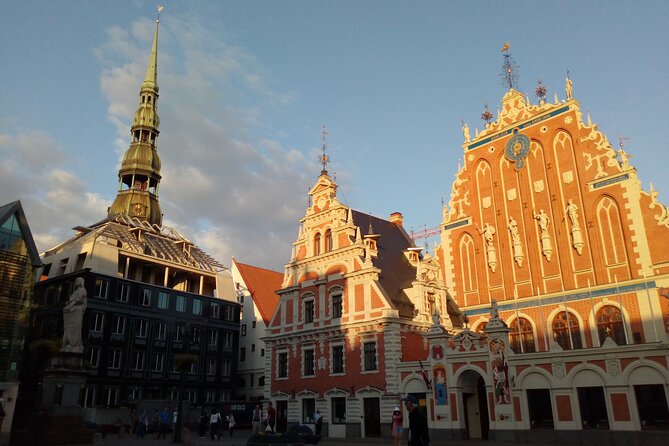
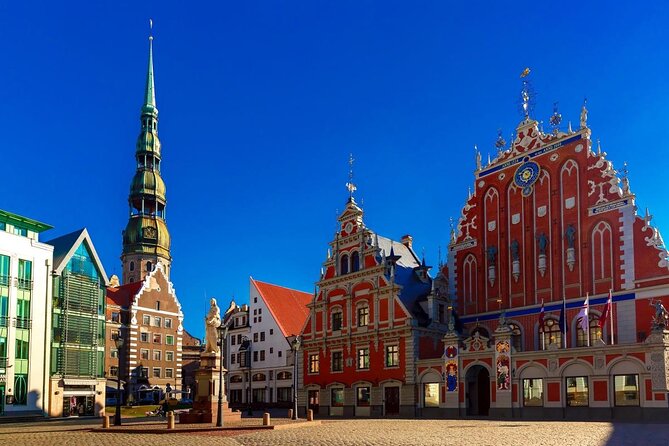
From here, the route moves to Riga Town Hall Square, or Ratslaukums. This was once a market and later became the city’s administrative and ceremonial center. The square now brings several layers of Riga together: the Daugava River, the Latvian National Library across the water, the Museum of the Occupation of Latvia, and the grand House of the Black Heads.
This is also where you hear the story of the key to Riga and the tradition of decorating a Christmas tree. A marker nearby recalls the decorated tree associated with Riga in 1510. The Christmas-tree claim is one of the city’s favorite bits of civic pride, and Lina connects it to the idea of Riga as a city with four capitals, a detail worth asking her to explain fully.
Black Heads, Roland, and medieval power
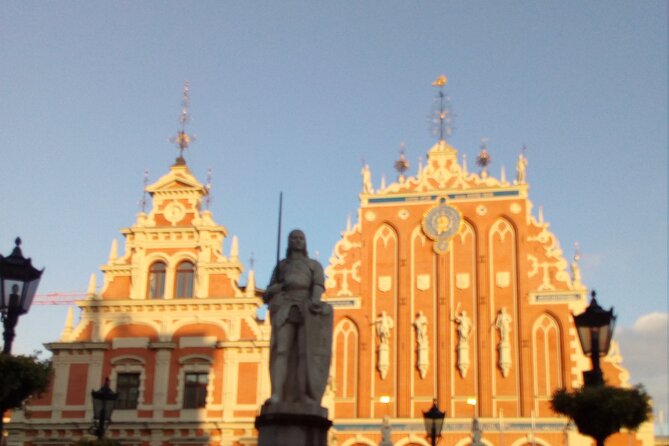
The House of the Black Heads is one of the most striking buildings on the square. Lina points out the facade’s elaborate decoration, the clock, and the symbols linked to the Brotherhood of the Black Heads, a group of unmarried merchants. You enter the free section and see part of the underground area, where the tour turns toward alchemical and hermetic symbolism.
The stop is short, but the building rewards close attention. Look at the facade as a coded display of status, trade, religion, and learning rather than just a colorful photo backdrop. The building’s surface tells you how much medieval and early modern Riga wanted visitors to notice its wealth.
In the center of the square, Roland’s statue represents medieval civic freedom and Riga’s place in the Hanseatic world. Riga joined the Hanseatic League in 1283, and the statue’s shield and sword carry their own story. This is a quick stop, but it helps explain why Riga’s merchants looked west as much as east.
You then pass through a City Hall passage on Jaunavu Street. Along the way are modern and symbolic touches, including the River of Time waterfall installation and a work called Contemporary of Pharaoh Tutankhamun. These brief details show that the Old Town is not a museum frozen in one century.
Narrow lanes, Bremen musicians, and cathedral roosters
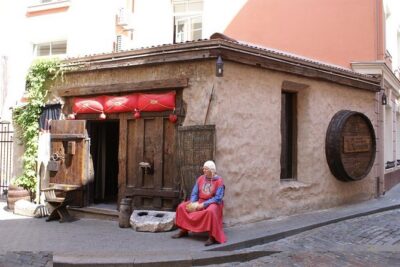
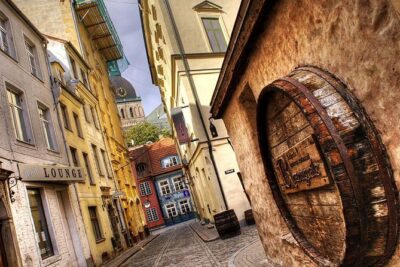
Rozena Street is one of the route’s most memorable small discoveries. It is described as Riga’s narrowest street, and you also see the exterior of a thirteenth-century city wine cellar. Lina explains why narrow lanes gained the nickname streets of the drunk knight, an amusing detail that makes the medieval street plan easier to picture.
The Bremen Town Musicians monument offers a lighter pause. Bremen gave the sculpture to Riga as a sister-city gift, and the monument also links back to Bishop Albert, traditionally associated with Bremen and the founding of Riga. The local custom says that touching the animals can help make a wish. You will probably see people trying it.
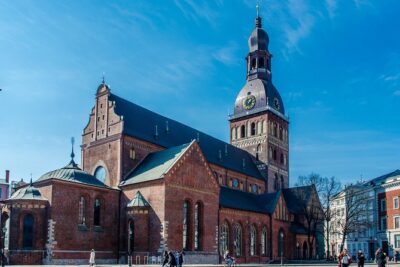
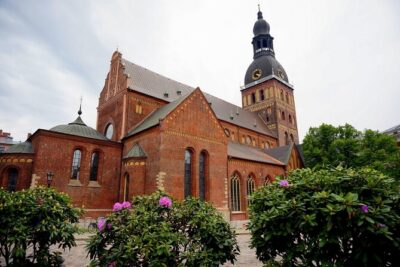
Dome Square opens the route into a larger civic space. Riga Cathedral, the city’s principal Lutheran church, faces the square, which also hosts the main Christmas market. Lina points out the golden roosters and explains the square’s geometry.
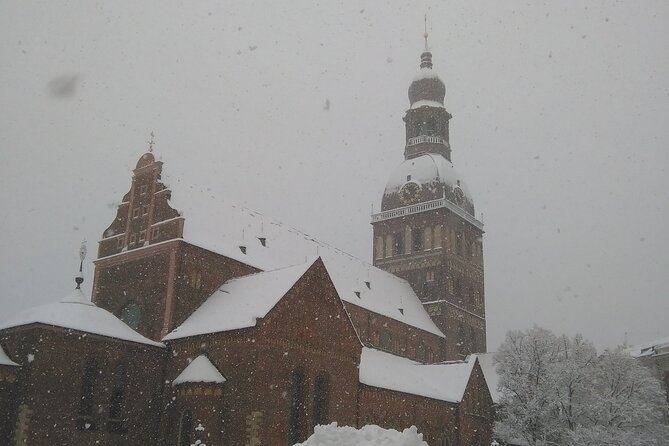
At Riga Cathedral, you visit the free part and hear about the building’s foundation and construction. The pipe organ is a major subject. It was once the world’s largest in the nineteenth century and is still regarded as one of the finest-sounding instruments. The cathedral rooster also had a practical role: Riga’s merchants used it as a rough guide when planning their day.
The tour does not promise a full cathedral visit or a concert. If the organ interests you, ask Lina for advice on returning independently.
A few more Riga trips to weigh up
- Old Town Walking Tour of Riga
★ 4.5 · 28 reviews - Riga Art Nouveau walking tour
★ 4.0 · 27 reviews - Riga walking guided Sightseeing tour
★ 5.0 · 19 reviews - Best Of Riga Walking Tour: Old Town
★ 4.5 · 19 reviews
A Venetian gondola and Riga’s oldest homes
The Riga Stock Exchange Building introduces a different style. Its Venetian Neo-Renaissance design is unusual in a northern European Old Town, and inside you can see the only Venetian gondola in Riga. The building now houses a foreign art museum. The stop gives you a useful reminder that Riga’s merchants and architects looked far beyond Latvia for ideas and trade.
The Three Brothers offer a more direct look at domestic life. These three adjoining houses form Riga’s oldest surviving dwelling-house complex, with each building showing a different stage in the development of home construction. You visit the oldest house, dating from the fifteenth century, and the Latvian Museum of Architecture.
A courtyard behind the houses contains Riga’s oldest coat of arms. Lina also explains the medieval window tax, a small but helpful detail about how governments once raised money from ordinary buildings. I like this section because it shifts your attention from grand churches and guild halls to the homes of people who actually lived in the city.
St. Jacob’s Catholic Cathedral is viewed from outside. The story here concerns the bell of the poor sinners, which rang when a condemned person was taken from prison to Town Hall Square for execution. It is a grim story, but it explains how churches and civic power once occupied the same tightly packed streets.
Fortifications, the Swedish Gate, and Black Magic Bar
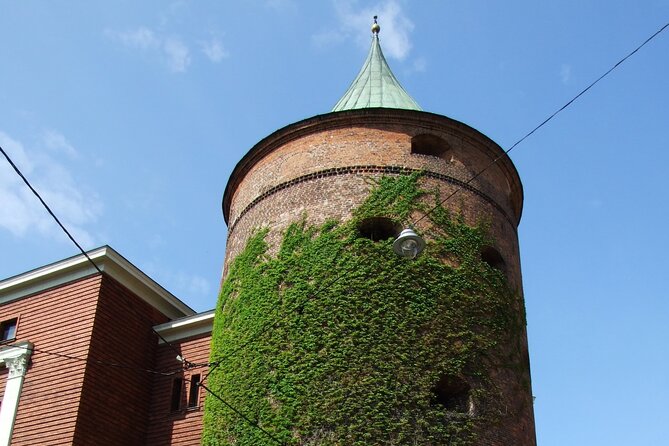
Powder Tower is Riga’s largest surviving fourteenth-century tower and one of the few remaining pieces of the old defense system. You see it from outside, and afterward you can visit the Latvian War Museum, which occupies the tower. Admission to the tower and museum is free, according to the tour information, so this is an easy place to return if you want more time.
The Swedish Gate is the only surviving outer gate of Riga, built during the Swedish period. Nearby, you hear about the house of the city executioner and the legend of the Riga ghost. The stories are brief, but the gate itself is a strong example of how the Old Town’s defensive past still appears in ordinary streets.
Jacob’s Inn, or the former St. Jacob’s barracks, is a long building that once housed 5,000 Swedish soldiers. Today, its shops, cafes, restaurants, and offices make it part of everyday Riga. I find this kind of contrast useful: the city’s old military buildings are not only monuments but working parts of the center.
The Black Magic Bar is the tour’s tasting stop. According to the local legend presented here, the site was once a pharmacy where Riga Black Balsam was invented in the eighteenth century. You sample the herbal drink and can see a secret door said to lead toward the alchemist Kunze’s laboratory.
The drink is a symbol of Riga, but it has a strong, bitter herbal profile that may not suit everyone. The tasting is included, and the cafe also serves coffee, tea, sweets, cakes, and mixed drinks based on different kinds of Black Balsam. You do not need to treat this as a bar crawl. Think of it as a short cultural stop with one local sample.
Freedom Monument, Laima Clock, and the cat legend
The Freedom Monument dates from the first Latvian Republic and carries major meaning for Latvian people. Lina explains its construction and the symbols built into the monument, making this more than a quick photograph.
You then pass Laima Clock, one of Riga’s main meeting points. Laima is Latvia’s largest chocolate producer, and the clock’s name comes from the company. This is a small stop, but it helps you connect the city’s public spaces with a familiar local brand.
The shortest street on the route is Kēniņu iela. You cross it quickly and hear how it became so short. At Cat House, Lina explains the legend behind the black cats that have become symbols of Riga. The story concerns the building’s owner and his relationship with the city’s guilds, so listen closely because the stop is short.
Livu Square follows, with its own history and a monument depicting a Liv head. The Small Guild and Great Guild then bring you back to the merchant and craft associations that shaped Riga’s public life. The Small Guild represented craftsmen, while the Great Guild, also known as St. Mary’s Guild, represented merchants and existed from 1354 to 1936.
The Baltic Way and the route back through old Riga
The Baltic Way footprint marker is easy to miss. This small red granite footprint recalls August 23, 1989, when about two million Latvians, Estonians, and Lithuanians joined hands in a human chain stretching 600 kilometers from Tallinn to Vilnius through Riga. The demonstration protested the fiftieth anniversary of the Molotov-Ribbentrop Pact while the Baltic states were still under Soviet occupation.
It is one of the most important modern-history moments on the route, yet the marker is modest. That contrast makes the stop worth your attention. You are not looking at a grand monument, but at a small reminder of a mass act of solidarity.
The route also points out the old Russian theatre, built during the Russian Empire in the second half of the nineteenth century. Its Florentine Neo-Renaissance design adds another architectural layer to Riga’s story.
At St. John’s Church, Lina tells the sad tale of two Dominican monks who were walled alive into the church. Their remains were found during nineteenth-century reconstruction, and you see the place associated with the discovery along with the oldest gate leading to the Dominican monastery.
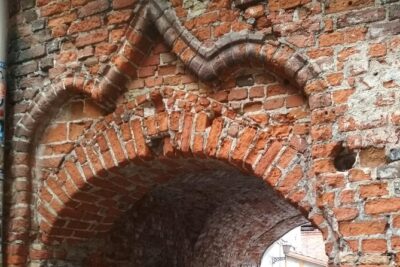
The final section includes part of the thirteenth-century fortification wall and Kalēju iela, the longest street in the Old Town. The street once followed the embankment of the Riga River, and blacksmiths worked there. You also see the Riga Radio and TV Tower in the distance, a 368.5-meter Soviet-era structure described as the tallest tower in the European Union.
The first Christmas Tree Marker returns you to the earlier story about Riga’s 1510 tree. Ending near that marker gives the route a neat historical loop, from medieval symbols to modern national memory.
Price, timing, and who gets the best value
The price is $108.43 per group of up to six people. For one person, that is expensive. For six, it works out to roughly $18 per person, before any taxes or other fees, which makes the private format a sensible deal for a family or small group.
The value depends on how you like to tour. You are paying for Lina’s explanations, local stories, route planning, and flexibility, not a long list of paid admissions. The walk includes a Black Balsam tasting and access to specified free areas, but many sights are exterior stops.
I would choose this for a first visit, a short stay, or a cruise call when you want a strong introduction in limited time. It also suits families with adults and older children, since the stories and visual folder keep the past from becoming a dry list of dates.
You should think twice if your main goal is extensive church interiors, museum time, or a slow architecture walk. Twenty-nine listed stops leave little time at each one. The tour is most useful as a guided framework, followed by your own return visits.
Pickup is offered, and the stated meeting information includes Grand Palace Hotel on Pils Street 12 as well as St. Peter’s Church at Reformacijas laukums. Because both are mentioned, confirm the exact starting point when booking. The activity is offered in English, runs Monday through Sunday between 10 a.m. and 6 p.m. during the stated operating period, and is available as a private activity. Confirmation is issued at booking, and cancellation is free up to 24 hours before the start time.
Should you book this Riga walking tour?
I would book it if you want stories, orientation, and small details more than formal museum guiding. Lina’s greatest strength is her ability to connect a church rooster, a medieval tax, a ghost story, a Soviet-era monument, and a Black Balsam tasting into one readable account of Riga.
Book it early in your stay so you can return to the cathedral, museums, guild buildings, or restaurants she points out. Choose comfortable shoes, allow two and a half hours, and confirm the meeting point. If you accept that most sights are viewed outside or through free-access sections, this is a personable and good-value way to get your bearings in Riga.
FAQ
How long does the walking tour last?
The activity is listed as approximately two hours and thirty minutes. The title refers to two hours, so allow the longer time when planning your day.
What is the price?
The price is $108.43 per group of up to six people. The cost is for the group, not each person.
Is this a private tour?
Yes. Only your group participates, with a maximum group size of six people.
Is the tour offered in English?
Yes. The tour is offered in English.
Where does the tour start?
The stated meeting information lists Grand Palace Hotel at Pils Street 12 in Riga. Pickup details also mention St. Peter’s Church at Reformacijas laukums, so confirm the exact meeting point before the tour.
Does the tour include church admission?
The route includes free parts of some churches, and several churches are viewed from outside. Paid full-interior visits are not described as part of the experience.
Is Riga Black Balsam included?
Yes. An alcoholic beverage tasting of Riga Black Balsam is included at a souvenir shop or Black Magic Bar.
Do I need comfortable shoes?
Yes. This is a walking tour through Old Town streets, and comfortable shoes are specifically recommended.
Can I visit the Latvian War Museum after seeing Powder Tower?
Yes. Powder Tower hosts the Latvian War Museum, and admission to the tower and museum is stated to be free.
What is the cancellation policy?
You can cancel up to 24 hours before the experience start time for a full refund. Changes or cancellations made less than 24 hours before the start time are not accepted for a refund.
More 2-Hour Experiences in Riga
- Small Group Art Nouveau walking tour 2h
★ 4.5 · 6 reviews
Just added around Riga
- Taste Riga – Private Tour of Latvian Flavour★ 5.0 · 5 reviews
- Ultimate Art Nouveau Experience in Riga – Private Tour★ 5.0 · 4 reviews
- Private Sightseeing Tour in Sigulda★ 5.0 · 4 reviews
- Sunrise at Kemeri National Park – Small Group★ 5.0 · 5 reviews
- CITY QUEST RIGA: unlock the mysteries of this city!★ 4.0 · 5 reviews
- Riga Shooting Range Trapitava★ 5.0 · 7 reviews
- Rundale Palace and Bauska Castle from Riga★ 5.0 · 3 reviews
- Riga’s Architecture: A self-guided audio tour of the city’s art nouveau history★ 5.0 · 3 reviews
Riga Old Town Walking Tours, compared.

Browse the lists this tour appears in