
Reviewed · TOURS
Riga Jewish History Tour
Riga’s Jewish story is written across the city, from elegant Art Nouveau buildings to the quiet memorial at Rumbula Forest. This private tour connects those places with the city’s prewar Jewish life, the Holocaust, refugee movements, and the small community that survived.
I like the private format, which lets you ask questions and spend longer at a site when it matters. I also like the way the route combines architecture with difficult history, rather than treating Jewish Riga as only a sequence of wartime memorials.
The main consideration is emotional weight. The synagogue burning, the Riga Ghetto, and the mass killings at Rumbula are painful subjects, and the tour moves between several memorial sites in a short morning. You should also budget extra for the synagogue donation and the €5 museum donation.
Key points before you book
- Rumbula Forest is the emotional center: You spend about an hour at the memorial where more than 25,000 people were killed in 1941.
- Art Nouveau has a Jewish connection: Mikhail Eisenstein designed several buildings in the district, and philosopher Isaiah Berlin was born in one of them.
- Private transport saves time: The route includes sites beyond central Riga, with pickup outside your hotel or apartment.
- Armands keeps the pace flexible: The guide has extended the tour when a group wanted more time at important places.
- The synagogue visit has an added cost: A donation is required on site, and a kipa is provided if your head is not already covered.
- Saturday needs planning: Some places may be closed for Shabbat, though the guide has substituted another site when needed.
Why this tour gives Riga’s Jewish past a human scale
Many history tours can leave you with dates but little sense of place. This one links ordinary streets, buildings, homes, religious life, and memorials. You begin with Riga’s cultural achievements and end by confronting how completely Nazi persecution destroyed much of the city’s Jewish population.
That order matters. Seeing the Art Nouveau district first helps you understand that Jewish life in Riga was not confined to one neighborhood or one religious institution. Jewish residents were architects, thinkers, business owners, refugees, worshippers, and neighbors. The later stops show how quickly that normal city life was broken.
The tour is private, so your group is the only group participating. That makes it easier to ask direct questions, pause for photographs, or speak quietly at a memorial without having to keep up with a large crowd.
Guide Armands receives repeated praise for his careful explanations, friendly manner, and willingness to admit when he does not know an answer. One especially useful feature is his flexibility. When a group wanted more time at the sites, he went beyond the planned schedule rather than rushing everyone back to the car.
The advertised length is about three to four hours. The scheduled visits add up to roughly three and a half hours, before considering driving between them. It is best treated as a substantial half-day outing, not a quick walk through central Riga.
A few more Riga trips to weigh up
- Cesis: Medieval Heritage and Natural Treasures
★ 4.0 · 4 reviews - Riga’s Architecture: A self-guided audio tour of the city’s art nouveau history
★ 5.0 · 3 reviews
Art Nouveau Riga, where architecture opens the story
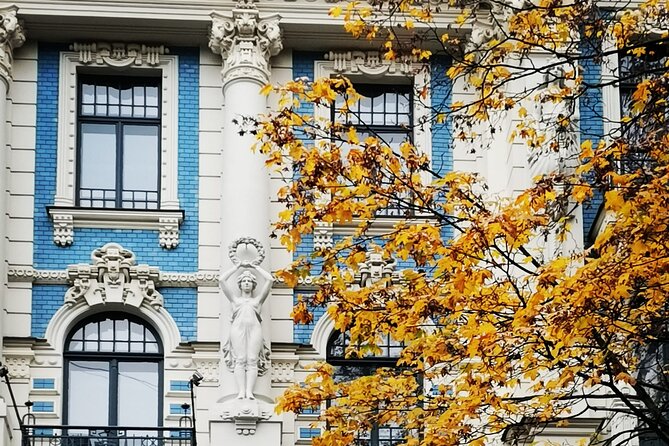
The first stop lasts about 30 minutes and focuses on Riga’s Art Nouveau district. This is a smart opening because the buildings give you something attractive to look at while the guide adds a less familiar layer of history.
Several buildings here were designed by Jewish architect Mikhail Eisenstein. One building was also the birthplace of philosopher Isaiah Berlin. Those details turn a familiar architecture stop into a lesson about the place of Jewish residents in Riga’s intellectual and professional life.
You will have time to take photographs, but the real value comes from the added context. Instead of seeing ornate facades as isolated works of architecture, you begin to connect them with the people who designed, lived in, or passed through this part of the city.
There is no admission charge at this stop. The limitation is time. Thirty minutes is enough for an introduction and photos, but not a full architectural study. If Art Nouveau is your main interest, treat this as a useful historical layer rather than a dedicated architecture tour.
Latgale Suburb and the former Riga Ghetto
The route then moves to Latgale Suburb, an area connected with the former Riga Jewish Ghetto. The visit lasts about 30 minutes and focuses on the physical setting of the wartime story.
The important point here is that some buildings remain in much the same form as they were about 80 years ago. That does not turn the area into a preserved museum. Instead, the surviving streets and structures help you picture the cramped, controlled world created during the German occupation.
This kind of stop requires careful explanation. Buildings alone cannot tell you who was forced to live there, how the area changed, or what happened to the people confined within it. Armands’ role is especially important here because the meaning lies in the connection between the present-day neighborhood and the events of the 1940s.
There is no admission fee. You should expect a reflective visit rather than a polished attraction with lots of displays. That is part of its power, but it may feel understated if you prefer traditional museums and formal exhibits.
Great Choral Synagogue Memorial and the crime of July 1941
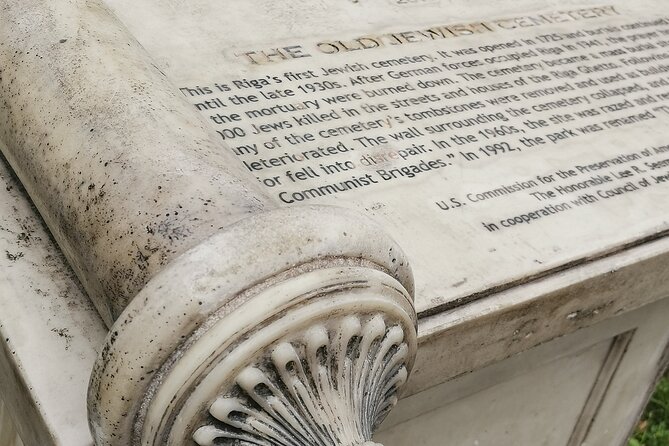
The Great Choral Synagogue Memorial is a short, 15-minute stop, but its story is one of the most disturbing on the route. On July 4, 1941, more than 300 Jewish refugees from Lithuania and local Latvian Jews were forced into the synagogue basement. The building was then deliberately burned.
A memorial now marks the site. You will not spend long here, yet the brief visit carries considerable weight because it shows how persecution moved from exclusion and confinement to open murder almost immediately after the German occupation.
The stop is best approached quietly. You may want to take a photograph of the memorial, but this is primarily a place to pause and listen. The guide’s tact matters here, and the tour’s strongest quality is its willingness to present the facts without turning tragedy into spectacle.
The memorial is free to visit. Since the stop is short, ask questions while you are there if you need help placing the event within the wider story of Riga’s Jewish community.
Same city, a completely different kind of day:
- Riga Old Town walking tour
★ 4.5 · 304 reviews - Latvian food tasting tour at Riga Central market
★ 4.5 · 241 reviews - 2 countries! Hill of Crosses, Rundale Palace and Bauska castle
★ 5.0 · 225 reviews - Discover Riga Bike Tour
★ 5.0 · 166 reviews
Rumbula Forest, the tour’s most sobering hour
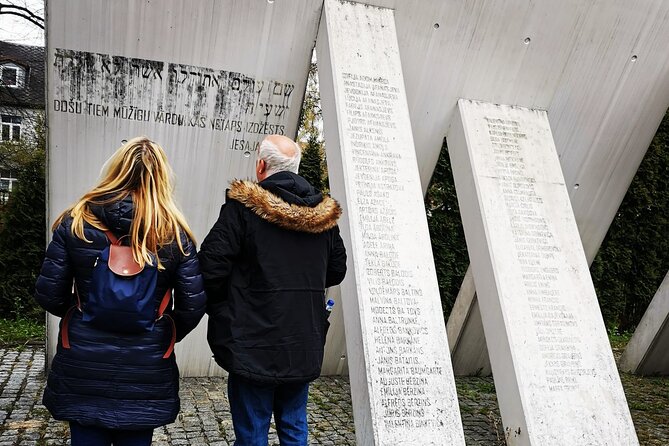
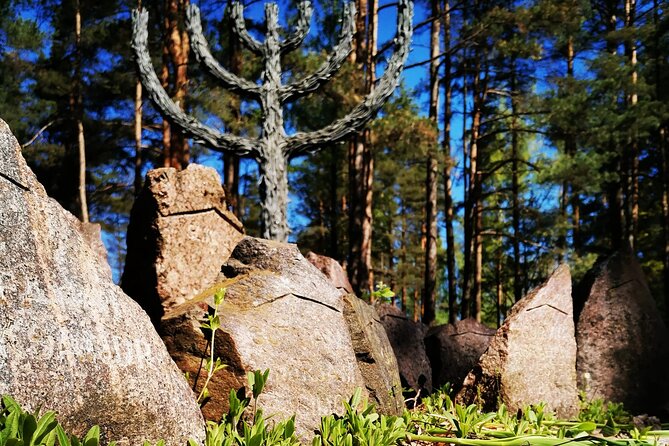
The visit to Rumbula Forest lasts about one hour, making it the longest stop. It is also the point at which the scale of the killings becomes hardest to avoid.
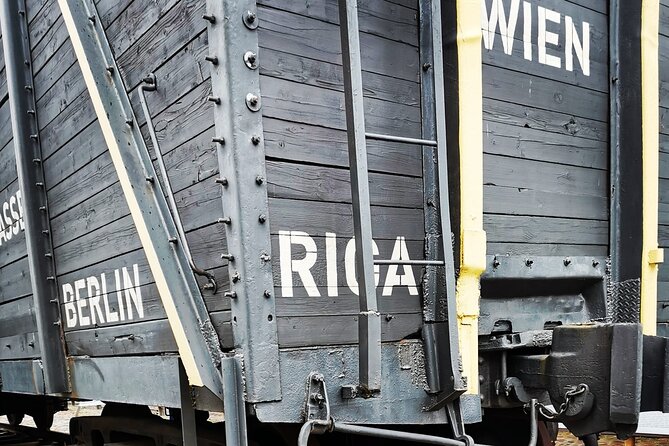
In November 1941, the Nazis decided to destroy the Riga Ghetto’s Jewish population. During mass shootings on November 30 and December 8, more than 25,000 people were killed in the forest. The dead included about 1,000 Jews deported from Germany.
The memorial was opened on November 29, 2002. Its setting is quiet, and that quiet creates a sharp contrast with the number of people murdered there. You have time to walk, look, and reflect instead of being hurried through in a few minutes.
I consider this hour essential to the tour, but it is not easy. The subject matter can be overwhelming, particularly after the earlier synagogue memorial and ghetto visit. If you are traveling with children or anyone who finds Holocaust sites especially difficult, think carefully about the pace and tone before booking.
The forest is also outside the central sightseeing area, which explains the value of private transportation. Getting there by car keeps the morning practical and gives the guide room to connect the site with the rest of the route.
Riga Ghetto and Latvian Holocaust Museum
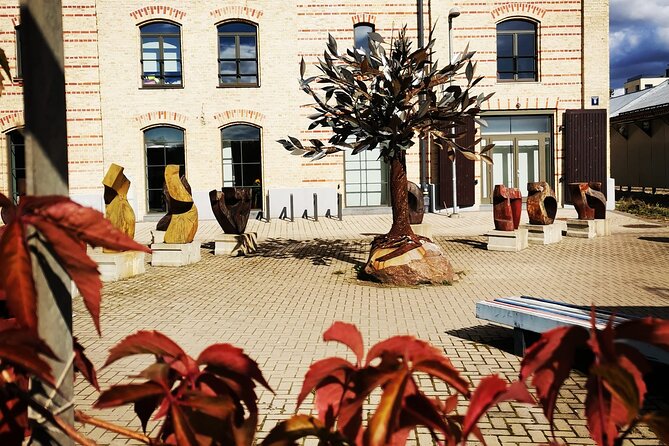
Back in the city, you spend about 30 minutes at the Riga Ghetto and Latvian Holocaust Museum. The museum focuses on three linked subjects: the Riga Ghetto, the Holocaust in Latvia, and Jewish life before the Holocaust.
That last part is important. A Holocaust museum can sometimes leave an audience with the impression that Jewish history began and ended with persecution. This museum also points toward the community that existed before the killings, giving the story a fuller human frame.
Thirty minutes is enough for an introduction, though you may want longer if you like to read every display. One person bought a book at the museum, which is worth keeping in mind if you want to continue learning after the tour.
The museum asks for a €5 donation per person. This is separate from the tour price, so include it in your budget. The visit is free in the sense that no admission ticket is included, but the stated donation is an expected extra.
Peitavas Street Synagogue, a surviving place of worship
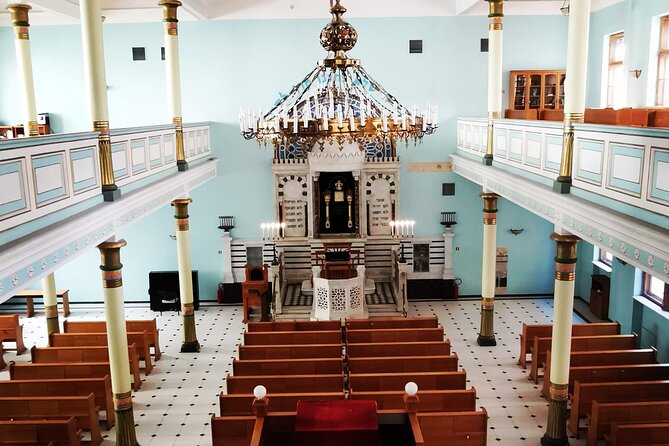
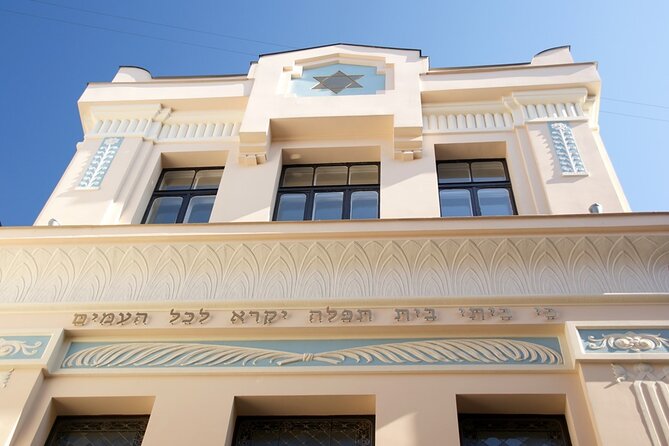
The final scheduled stop is Riga Synagogue on Peitavas Street, with about 45 minutes set aside for the visit. The building was constructed between 1903 and 1905 and designed in the Art Nouveau style with Ancient Egyptian motifs.
It is both a religious building and a cultural monument. After a morning spent looking at destroyed institutions and memorials, entering a functioning synagogue gives the tour a different tone. The history is still present, but the stop also points to continuity.
A donation is required at the synagogue and is not included in the tour price. If your head is not covered by a cap, hat, or scarf, a kipa will be provided. The stated dress rule is simple: ordinary clothing is fine, provided you are not naked.
The 45-minute visit allows time for an explanation and questions. The synagogue may not be available in the same way on Saturday, since Shabbat affects opening arrangements. One Saturday group was taken to another place of interest when some sites were closed, so the private structure can help, but you should still expect the day’s plan to change slightly.
What the $96.33 price really covers
The listed price is $96.33 per person. That is not a bargain-basement city walk, but it includes private transportation and guide services for a route that reaches several locations beyond central Riga.
The value depends heavily on your group size. For one person or a couple, the cost is a serious outlay. For a small private group, the price becomes easier to justify because you are paying for a dedicated vehicle, a personal guide, and the ability to ask questions throughout the morning.
You are also buying time. Rumbula Forest and the ghetto area are not simply adjacent sights in Old Riga, and reaching them independently would require more planning. Private transport keeps the route together and avoids spending much of the morning sorting out connections.
Remember the extras: a donation at the synagogue and €5 per person at the Holocaust Museum. These are modest compared with the tour cost, but the final total will be higher than the advertised figure.
Group discounts are offered, though the exact reduction is not provided. If you are booking for several people, check the final price before deciding.
Practical details that can shape your morning
The start time is 9:00 am. Pickup is offered, but you should wait outside your hotel or apartment because the vehicle is not allowed to park in Old Riga. This is a small detail that can prevent a frustrating start.
The experience is offered in English and uses a mobile ticket. Confirmation is received at booking, and most people can take part. The tour is private, so only your own group participates.
Wear comfortable clothing suitable for a morning that includes walking and outdoor memorials. No special dress code is required beyond the synagogue’s head-covering arrangement. The guide can provide a kipa when needed.
The tour is free to cancel up to 24 hours before the start time for a full refund. Cancellations or changes made less than 24 hours before the start are not refunded or accepted, and the cut-off follows local time.
The tour is booked, on average, 59 days ahead. That figure suggests you should not leave it until the last moment if the date matters to you, especially if you want a particular morning during a short Riga stay.
Who will get the most from this experience
I would choose this tour if you want Jewish history placed directly into Riga’s streets and neighborhoods. It suits people who prefer a guide-led visit to several memorials rather than a single museum, and it is particularly useful when you want to ask detailed questions.
It also works well for families or small groups with different interests. Someone drawn to architecture gets Art Nouveau Riga and the synagogue, while someone focused on the Second World War gets the ghetto, museum, synagogue memorial, and Rumbula Forest.
The private format is a strong fit for anyone who dislikes fixed group pacing. You can request more time at a stop, and the guide has shown a willingness to add an extra site or adjust the plan when circumstances require it.
I would hesitate to book it as a light morning activity. The Holocaust material is central, not incidental. You should be ready for a serious, sometimes painful experience, with long stretches of reflection rather than cheerful sightseeing.
Should you book the Riga Jewish History Tour?
Book it if you want a focused, personal account of Riga’s Jewish past, and if visiting Rumbula Forest matters to you. The combination of private transport, Armands’ flexible guiding, architectural context, museum time, and memorial visits gives the morning a clear shape and real substance.
Skip it if you want a relaxed architecture outing or find Holocaust sites too difficult. Also check your date carefully if you plan to visit on Saturday, since Shabbat can affect what is open.
For most visitors with a serious interest in Riga’s Jewish heritage, the tour offers good value despite the extra donations. It takes you beyond the postcard center and helps you see both the life that existed before the Holocaust and the terrible losses that followed.
FAQ
How long does the Riga Jewish History Tour last?
The tour lasts approximately three to four hours. The scheduled visits total about three and a half hours, not counting the driving time between locations.
What time does the tour start?
The tour starts at 9:00 am.
Is hotel pickup available?
Yes. Pickup is offered from outside your hotel or apartment. The vehicle cannot park in Old Riga, so you should wait outside the accommodation.
Is transportation included?
Yes. Private transportation and guide services are included.
Are donations included in the price?
No. A donation is required at the synagogue, and the Holocaust Museum requests a €5 donation per person.
Can the tour operate on Saturday?
Yes, but some places may be closed for Shabbat. The guide can adjust the route and visit another place of interest when needed.
Just added around Riga
- Taste Riga – Private Tour of Latvian Flavour★ 5.0 · 5 reviews
- Ultimate Art Nouveau Experience in Riga – Private Tour★ 5.0 · 4 reviews
- Private Sightseeing Tour in Sigulda★ 5.0 · 4 reviews
- Sunrise at Kemeri National Park – Small Group★ 5.0 · 5 reviews
- CITY QUEST RIGA: unlock the mysteries of this city!★ 4.0 · 5 reviews
- Riga Shooting Range Trapitava★ 5.0 · 7 reviews
- Rundale Palace and Bauska Castle from Riga★ 5.0 · 3 reviews
- Riga’s Architecture: A self-guided audio tour of the city’s art nouveau history★ 5.0 · 3 reviews
Tours, compared.

Latvian food tasting tour at Riga Central market
Read our review →
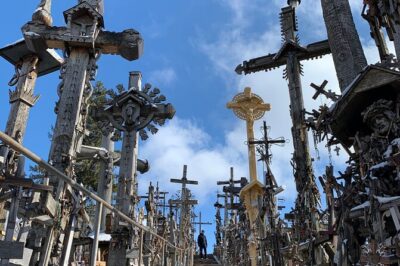
5,5 Hour Small Group Tour to Hill of Crosses from Riga
Read our review →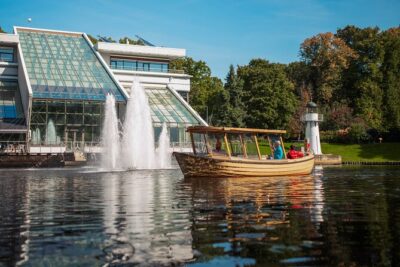
Riga Sightseeing Tour by Canal Boat with Audioguide
Read our review →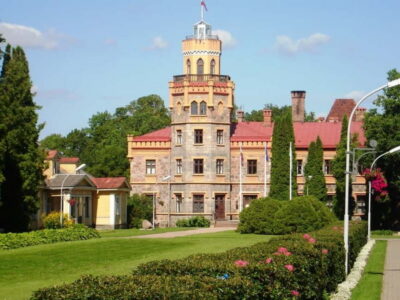
Private Sigulda, Turaida, and Gauja National Park Tour
Read our review →Browse the lists this tour appears in